


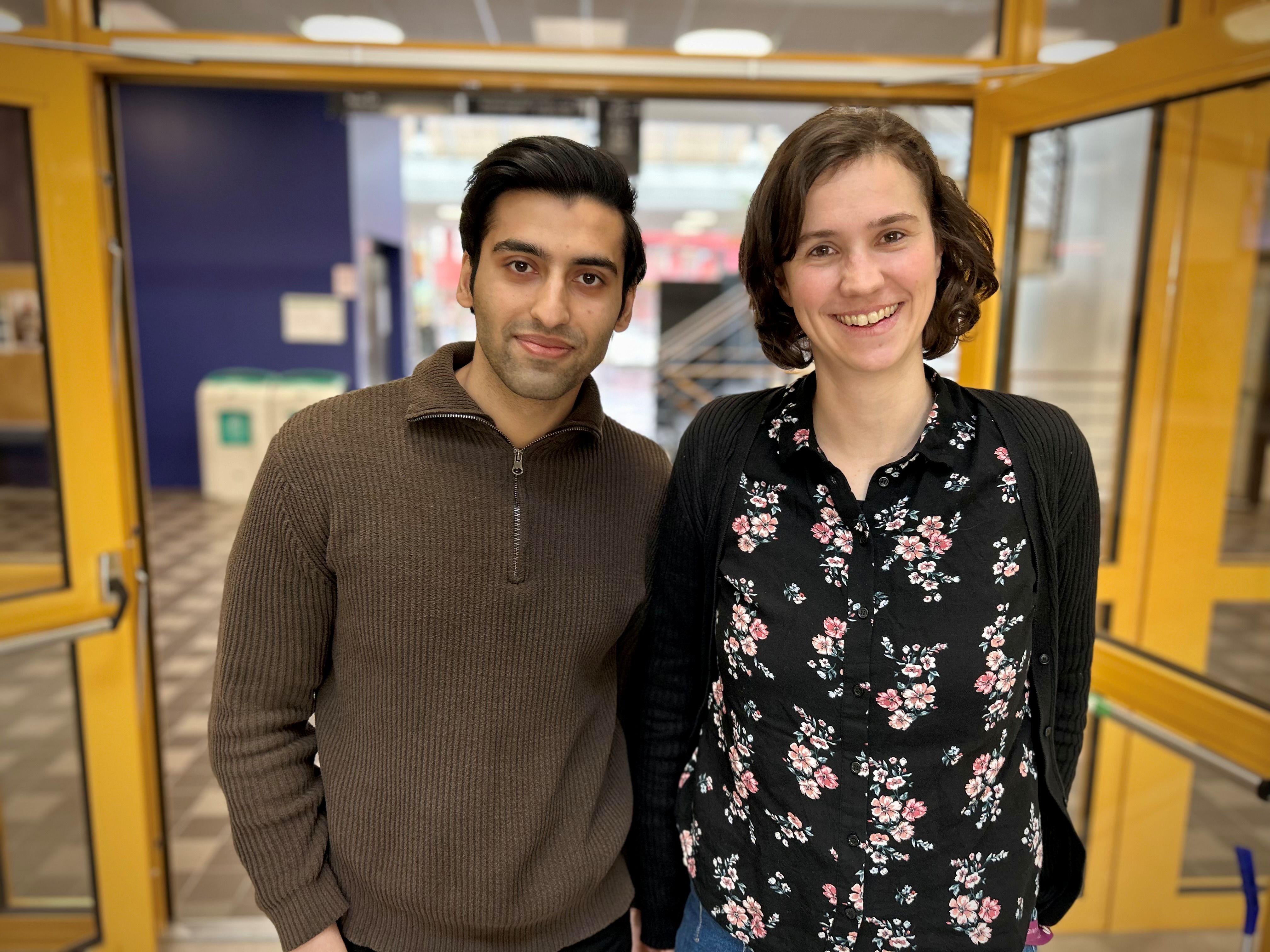
From left to right: Abdul Wahab and Sinah Malz, PhD students within the GRACE-project ReShare.
New doctoral students provide in-depth analysis of the industry
Facts are needed to make the right decisions when product development and manufacturing are to be shifted in a more sustainable direction. Now, the industry is getting help from two new doctoral students who have joined the ReShare research project to tackle this complex challenge.
Doctoral students Sinah Malz and Abdul Wahab are two new faces in the GRACE project ReShare, which focuses on creating the conditions for more sustainable products and production. This is achieved, among other things, by structuring new information, new requirements, and, not least, by producing new research results on various alternatives and methods during a product design and manufacturing process. One of the goals is to reach a common understanding within the industry; one might compare it to the need for a shared map of the best routes toward the green transition.
"My research is about how a shared understanding in a company of what we must measure and how we can measure it can lead to more sustainable product and production development. Performance indicators can help with that by showing, which option is actually more sustainable. For example, reducing waste in production may seem beneficial, but if doing so demands more energy, it might not be the more sustainable choice, explains doctoral student Sinah Malz. She has a background as a biomedical engineer in Rostock, where she moved from working with "bodily" technology such as prosthetics, stents, and heart pumps to becoming increasingly curious about the materials themselves.
The growing interest in sustainability and circularity led her to the School of Engineering (JTH) at Jönköping University. Without any prior connection to JU or Sweden, she left Germany for Småland.
"I wanted to deepen my knowledge in that specific area and and collaborate more directly with companies," says Sinah, who now combines her research in ReShare with teaching at the School of Engineering.
Smarter manufacturing: a step toward sustainability
Abdul Wahab came from Pakistan to Jönköping seven years ago and began his career at JTH as a student. After studying Supply Chain Management and production engineering, he delved into how an idea becomes reality. He now focuses on the early phases of product and production development and how the two processes should work in collaboration to increase sustainability and circularity throughout the product lifecycle.
"It’s also about how the product itself should be designed from the start and which methods, tools and techniques should be used during manufacturing," Abdul explains, describing the "platform thinking" that is a key element of his work with companies. Simply put, it is a way of designing products or systems so that many different versions can be built from the same basic foundation. By having a shared base (platform) and then building variations on top of it.
For example, by working more modularly and using the same equipment for future generation of products to reduce development time.
"Fundamentally, it's about economics," says Abdul, who is currently working with eight companies of varying sizes to structure their processes and make them more sustainable and circular for the long-term. These are businesses that must adapt to avoid a "Nokia situation," he says, describing how the well-known mobile phone company had the design but lacked the right mindset.
Sinah and Abdul work closely with the companies, conducting interviews and discussing challenges in workshops. Sinah describes how she dives deep into the operations to determine which questions need to be asked, which metrics and indicators are important, and what information is required to find solutions. However, to leave the current "take, make, waste" stage, politics and consumers must also be part of the journey, she argues.
"I hope for big changes," says Abdul Wahab. "Companies want to and must improve, but some don’t even know what platform thinking is," he explains.
But, with Abdul and Sinah in the ReShare project, the industry's knowledge of the major challenges ahead will increase significantly!


