
Research shows how comic art can be used as an educational tool
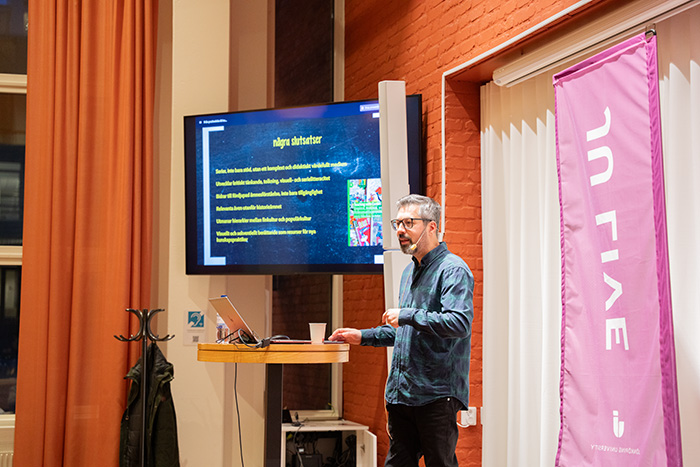
Radu Dinu gave a lecture at JU LIVE on Thursday, 29 January.
After a Christmas break, the popular lecture series JU LIVE is back. Radu Dinu, Associate Professor of History, held the first popular science lecture of the spring semester, where the audience was invited to reflect on comic art as a source of knowledge in education.
Radu Dinu, who conducts research at the School of Education and Communication (HLK) at Jönköping University, began with a little history and explained that humans have communicated with images since ancient times. He cited the ancient pictographic writing system of hieroglyphics, which was used for over 3,000 years, as an example. He also gave some examples of the important role that comic art has played over the years and mentioned that Art Spiegelman won the Pulitzer Prize in 1992 for his graphic novel Maus: A Survivor's Tale.
Interviews with teachers and teacher students
Radu talked about a research project (EduComics) that he and some colleagues are conducting on how comics can strengthen visual literacy (the ability to absorb, understand and use different types of communication) and promote social justice. He presented parts of two sub-studies. In the first they interviewed teachers in the United States, Turkey and Sweden who use comics in their teaching. The audience got to hear quotes from teachers, most of whom are positive about the teaching method. One teacher said that it is a positive bridge to pure text for young people who do not read much to begin with. Another teacher said that the pupils had not read comic books before, so they first had to learn how to follow the boxes on the page.
Radu also talked about the second sub-study conducted at HLK, in which teacher students were interviewed. Here too, the idea of supplementing text-heavy course literature with comic art to activate more senses was received positively.
The lecture ended with the audience asking Radu questions.
“It was very inspiring to meet such an engaged and curious audience. It is also a useful challenge for researchers to formulate their results in an accessible and concrete way,” he says.
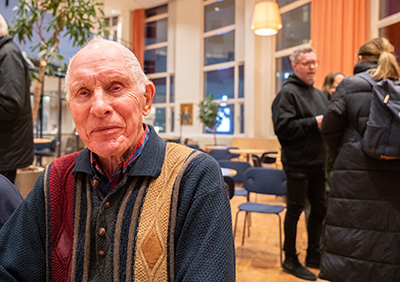
“You gain new perspectives on things”
It was not the first time that Kurt Eriksson, one of the audience members, had been to JU LIVE. He thinks the concept of open lectures is good.
“I am generally interested in listening to different lectures, but today's topic of comic art was interesting, as it is not something one thinks about daily. I thought the lecturer was very good, very focused and well-prepared. These open lectures that are accessible to the public are appealing, as they provide new perspectives on things,” says Kurt Eriksson.
Radu Dinu believes that JU LIVE and other open lectures are important.
“Universities should collaborate with the surrounding community and create opportunities for interaction between academia and the outside world, which JU LIVE facilitates in an easily accessible way. This makes knowledge more relevant, and the fact that it takes place in a relaxed environment is a plus. I hope that even more people will take the opportunity to learn about the research being conducted at Jönköping University. It contributes to a lively dialogue about knowledge in both Jönköping and the region,” says Radu Dinu.

- Assistant Professor of History
- School of Education and Communication
- radu.dinu@ju.se
- +46 36-10 1641
Upcoming lectures (Please note that all lectures are held in Swedish):
26 February: Sustainable preparedness – an educational issue for our time of destiny
Joakim Netz, Assistant Professor of Work Organization, School of Engineering at Jönköping University
26 March: Surviving the war is just the beginning – about amputation and the road back to life in Ukraine
Nerrolyn Ramstrand, Professor of orthopaedic technology, School of Health and Welfare at Jönköping University
23 April: To be announced shortly – keep an eye on ju.se/julive.


